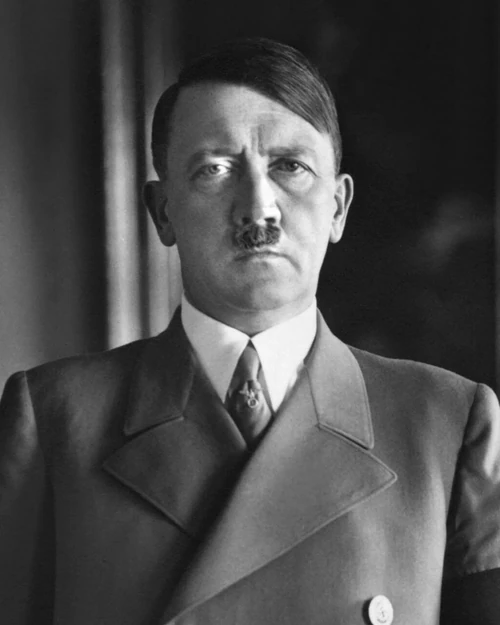
 Bundesarchiv, Bild 183-H1216-0500-002 / CC-BY-SA. CC BY-SA 3.0 de: https://creativecommons.org/licenses/by-sa/3.0/de/deed.en. Cropped to a 4:5 portrait, resized without upscaling, converted to sRGB and compressed as WebP. Source: https://commons.wikimedia.org/wiki/File:Hitler_portrait_crop_(cropped)(2).jpg. Full credits: /portraits/credits.html#adolf-hitler
Adolf Hitler
Play NowAdolf Hitler led Nazi Germany from 1933 to 1945, destroying parliamentary government and concentrating power in his own leadership. Political opponents were imprisoned and independent institutions brought under Nazi control. His regime’s racist ideology culminated in the Holocaust, the systematic murder of six million Jews, alongside the persecution and killing of millions of others. Abroad, territorial conquest drove a devastating European war. Economic policy served these ambitions: the Four-Year Plan sought to reduce dependence on imported fuel and raw materials while preparing Germany for war. Private businesses continued to operate, but their activities were subordinated to rearmament and state priorities. Hitler’s pursuit of economic self-sufficiency was therefore bound up with dictatorship and expansion, rather than simply a preference for protecting domestic firms from foreign competition.
Challenge dimensions
- Governance
- Democratic Autocratic
- Trade
- Protectionism Free trade
Further Reading
The Rise and Fall of the Third Reich
Adolf Hitler: My Part in his Downfall (Spike Milligan War Memoirs)
As an Amazon Associate, I earn from qualifying purchases.