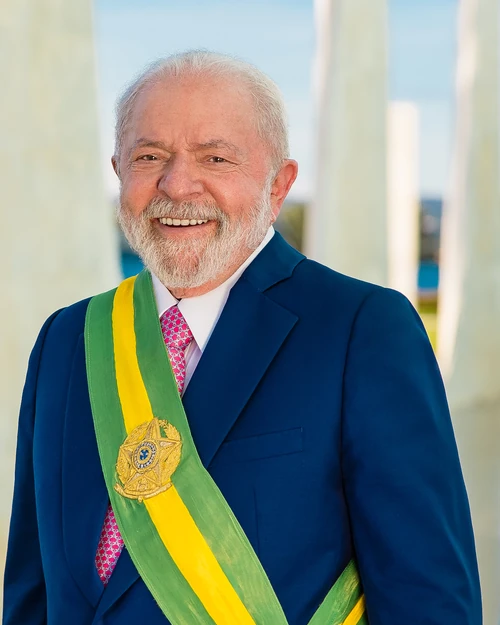
 Ricardo Stuckert/PR. CC BY 2.0: https://creativecommons.org/licenses/by/2.0/. Cropped to a 4:5 head-and-shoulders portrait, resized without upscaling, converted to sRGB and compressed as WebP. Source: https://commons.wikimedia.org/wiki/File:Foto_oficial_do_Presidente_da_Rep%C3%BAblica_Luiz_In%C3%A1cio_Lula_da_Silva.jpg. Full credits: /portraits/credits.html#luiz-inacio-lula-da-silva
Luiz Inácio Lula da Silva
Play NowLuiz Inácio Lula da Silva, known as Lula, emerged from Brazil’s metalworkers’ movement and helped found the Workers’ Party in 1980. After leading the party, he served as president from 2003 to 2010 and returned to office in 2023. His governments made social programmes, notably Bolsa Família, central to their approach to poverty. Economically, he favours an active state: public investment, development finance and industrial policy operate alongside private enterprise and markets. Internationally, he promotes multilateral institutions, cooperation among developing countries and BRICS as a platform for reforming global governance. Yet this internationalism also serves Brazilian sovereignty and national development. These tensions matter for the game: support for state direction does not imply abolishing markets, while international cooperation does not mean abandoning national interests. The two positions are editorial estimates of a pragmatic political record.
Challenge dimensions
- Economic coordination
- Planning Markets
- Internationalism
- Internationalist Nationalist
Further Reading
Lula!: The Man, The Myth and a Dream of Latin America
Beef, Bible and Bullets: Brazil in the Age of Bolsonaro
As an Amazon Associate, I earn from qualifying purchases.