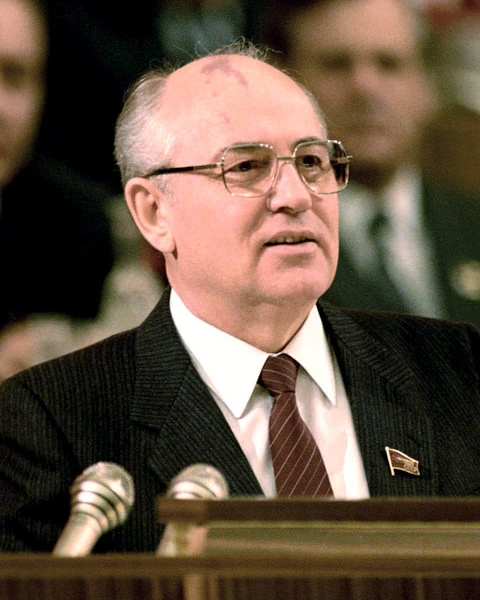
 RIA Novosti archive, image #850809 / Vladimir Vyatkin / CC-BY-SA 3.0. CC BY-SA 3.0: https://creativecommons.org/licenses/by-sa/3.0. Cropped to a 4:5 portrait, resized without upscaling, converted to sRGB and compressed as WebP. Source: https://commons.wikimedia.org/wiki/File:RIAN_archive_850809_General_Secretary_of_the_CPSU_CC_M._Gorbachev_(crop).jpg. Full credits: /portraits/credits.html#mikhail-gorbachev
Mikhail Gorbachev
Play NowMikhail Gorbachev became Soviet leader in 1985 intending to renew socialism rather than dismantle the Soviet Union. His programmes of glasnost and perestroika opened public debate and attempted to revive an economy dominated by state planning. He supported greater enterprise autonomy, cooperatives and a larger role for market activity, while continuing to seek a reformed socialist system. Political changes allowed more competition and weakened the Communist Party’s monopoly, helping to release pressures his government could not contain. His refusal to sustain Eastern European communist regimes by force contributed to the Cold War’s end. At home, however, Soviet troops still used violence against independence movements, including in the Baltic republics. His record combines substantial political opening with economic caution and an ultimately unsuccessful effort to preserve the union through reform.
Challenge dimensions
- Governance
- Democratic Autocratic
- Economic coordination
- Planning Markets
Further Reading
Gorbachev: The Man and His Era
Collapse: The Fall of the Soviet Union
As an Amazon Associate, I earn from qualifying purchases.